
Kāphal Festival 2026: Why This Little Village in Rudraprayag Is Where the Future of Himalayan Travel Begins
A wild berry, a folk band, and a community that refused to let its mountains go silent — the story of Kāphal Festival and what it means for conscious travellers in India.
If you have grown up anywhere near the Garhwal Himalayas, you already know the Kāphal. That small, deep-red berry that grows on the Myrica esculenta tree, shows up for just a few weeks every summer, and then quietly disappears back into the oak-rhododendron forests. You can’t buy it in a supermarket. You won’t find it packaged on a grocery shelf. It belongs completely to where it grows — to the altitude, the soil, the cool mountain air, and the stories people tell while picking it.
Someone once described the Kāphal as “the taste of the mountains in a single bite.” That description is not just poetry. It is a philosophy. And it is this same philosophy that gave birth to one of the most honest, most grounded, and most overdue festivals to come out of Uttarakhand in recent years — the Kafal Festival.
Born in the summer of 2025 in the terraced fields of Sari village, tucked away in Rudraprayag district at 2,000 metres above sea level, the Kāphal Festival is back in 2026. And this time, it arrives in the sacred month of Chaitra — when the forests flush with Burāṃs, Paiyiā, and Phyolī announces the arrival of the Himalayan spring.
This is not a music festival with a sustainability tagline slapped on the poster. This is something rarer and more important. As Himalayan Geographic put it after attending the inaugural edition in 2025: “In both substance and style, the Kāphal Festival has raised the bar — decisively and unapologetically.”
Here at Ecorahi, we believe in exactly the kind of travel that Kāphal Festival stands for — travel that supports local people, respects local nature, and leaves a community stronger than it found it. Which is why we think every conscious traveller in India needs to know this story.
“The mountains don’t need a stage. They are one.”
First, Let’s Talk About the Village
Sari is not unknown to trekkers. Most people who have done the Deoria Tal trail have passed through it — filled their water bottles there, grabbed a cup of chai, and moved on toward the lake. And Deoria Tal deserves every bit of attention it gets. On a still morning, that glacial lake holds a near-perfect mirror reflection of the Chaukhamba massif, and it is one of those sights you genuinely never forget.
But here is the thing about Sari that most trekkers miss entirely: the village itself is extraordinary. It sits in the Ukhimath block of Rudraprayag district, surrounded by terraced wheat and barley fields on one side and thick mixed forests on the other. The Uttarakhand government recognised Sari as an eco-tourist village as far back as 2006 — one of the earliest such designations in the state.
Yet for decades, Sari’s relationship with tourism has been mostly that of a waypoint. Trekkers sleep, eat breakfast, then leave. Pilgrims pass through on their way to Tungnath, Chopta, or the Panch Kedar route. The village has always hosted people, but rarely on its own terms.
The Kāphal Festival set out to change that relationship permanently. Not by turning the village into a performance for outsiders, but by inviting the outside world to come and listen — truly listen — to what this place has been saying for centuries.
Pandavaas: The Band That Carries the Mountains in Its Music
To understand what the Kāphal Festival is trying to do, you first need to understand Pandavaas.
Founded in 2008 by three brothers from Uttarakhand — Ishaan, Kunal, and Salil Dobhal — Pandavaas is not a regular band. They are, in the truest sense, folk custodians who happen to make music. Ishaan is the composer and the “Folk Fankar,” the folk artist whose voice and compositions have become synonymous with Garhwali music for a new generation. Kunal brings a background in theatre and performing arts to the music videos, giving each release a visual depth that is rare in Indian regional music. And Salil — known as the “eye of Pandavaas” — is the Director of Photography whose lens has captured the Himalayas with a care that goes far beyond the picturesque.
Together, they are based out of Rudraprayag. The same district as Sari village. That is not a coincidence. Their music — albums like Maangal (traditional Garhwali wedding folk songs), Ranchana, and the Dhunyaal series — is music that could only have been made by people who grew up walking these forests, waking up to these views, and speaking Garhwali at the dinner table. Today, Pandavaas has over 254,000 monthly listeners on Spotify and more than 123,000 followers on Instagram. But those numbers are almost beside the point.
What matters is the mission. Pandavaas has always understood something that larger platforms often miss: that Garhwali folk music is not just entertainment. It is living ecological knowledge encoded in song. A Garhwali song about the Mandakini river is a song about water stewardship. A folk tune about the forests of Garhwal is a song about conservation. And a Maangal wedding song is a living ritual that holds entire communities together across generations.
When Pandavaas decided to launch the Himalayan Folk Festival and its flagship event, the Kāphal Festival, it was a natural extension of fifteen years of this work. The mountains had always spoken through their music. Now they wanted to let the mountains speak directly.
What Actually Happened at Kāphal Festival 2025
The inaugural Kāphal Festival ran for five days across the Sari–Deoria Tal landscape in June 2025. Five days is a long time for a grassroots community festival. And every single one of those days was used with intention.
As reported by News Post, the event brought together visitors from across India and overseas, weaving together ecology, folk art, sustainability, and community in a way that felt entirely natural — because it was.
Photography that actually meant something
The festival opened with a three-day photography workshop at Deoria Tal, mentored by Salil Dobhal and photographer Mohammad Asif. The participants — including one who had travelled all the way from Germany — were not just taught techniques. They were guided in a particular way of seeing: how to photograph a forest ecosystem with respect, how to document village life without treating people as subjects, how to build a narrative through a lens that honours what it captures. This is a kind of photography education you simply do not get at a weekend workshop in a city.
The trail got cleaned. Properly.
In partnership with Tameer Artivists Foundation, the festival organised a full cleanliness drive along the entire 3-kilometre trek route from Sari to Deoria Tal. More than two dozen volunteers walked the route, collected waste, and installed handcrafted bamboo dustbins made from ringal — local Himalayan bamboo — at regular intervals along the trail. Every bit of collected waste was responsibly transported back to a designated waste management centre. The entire five-day event was designed to be 100% plastic-free. Water partner Amritdhara installed free refill stations across the festival grounds. Rice husk glasses replaced every single-use plastic cup.
This might sound like small stuff. It is not. The Deoria Tal trail has struggled with waste accumulation for years. The festival did not just talk about the problem — it physically fixed a portion of it, and left behind infrastructure to prevent its return.
The food table told its own story
Local women from Sari prepared and served the food at the festival. The menu was almost entirely made of dishes you cannot order on Swiggy: Mandua-based (finger millet) preparations, traditional Arsa sweets, village-style Pakoras, Jalebi, and Rotana, alongside fresh Buransh juice and local herbal teas. This was not a curated ‘food experience’ designed for Instagram. It was everyday Garhwali home cooking, made by the people who cook it every day, shared with visitors on equal terms.
Conversations that needed to happen
A panel discussion titled “Wildlife, Forest Fires, and Local Culture” brought together Dr. S.P. Sati from VCSG University Bharsar, Kailash Nautiyal from Village Dimli, and Upendra Singh from Sari village itself, moderated by Rahul Kotiyal. They spoke about sustainable tourism, the ecological threats facing the Garhwal region, and the urgency of preserving indigenous knowledge of forests. These are not abstract policy conversations. In Uttarakhand, where the summer of 2024 saw devastating forest fires across hundreds of hectares, they are deeply urgent ones.
Mangal songs, poetry, and Pandavaas
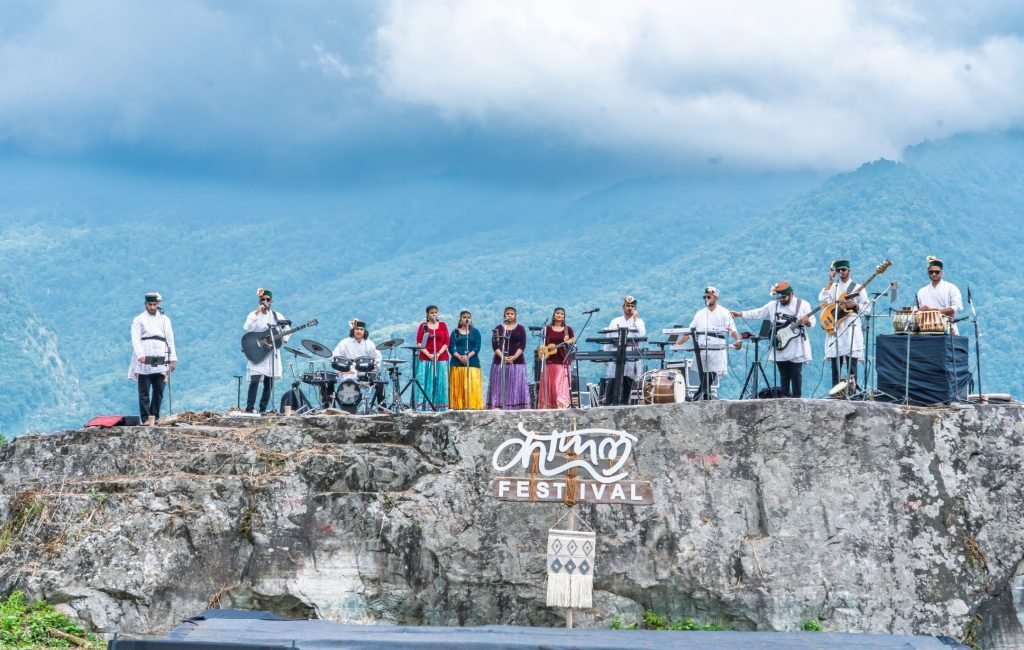
Folk singers Rameshwari Bhatt, Narmada Bhatt, Kubja Devi, Sureshi Devi, Pareshwari Negi, and Sulochana Bhatt performed Mangal songs — traditional Garhwali folk music typically sung at auspicious occasions. Veteran poet Om Prakash Semwal curated an evening of poetry with themes of nature, rural life, and the land. And the highlight of the five days was the live performance by Pandavaas themselves, weaving traditional Garhwali arrangements with contemporary layering in a setting that felt like the music had always been meant to be heard exactly here, under these skies, facing these peaks.
Kāphal Festival 2026: It’s Happening Now — And It’s Bigger
The Kāphal Festival 2026 takes place on 20–22 March 2026 in Sari village — the same sacred ground, the same community, but a considerably expanded programme.
This edition is celebrated in the month of Chaitra — when the forests around Sari are alive with blooming Burāṃs (Rhododendron), Phyolī, Sākini, and Paiyāṃ. The Kāphal berries are just beginning to appear. The landscape is doing what it does best: reminding you why any of this matters.
The 2026 programme brings together music, sport, craft, and nature — all in one extraordinary mountain setting:
- Forest Run 21.1 – Kāphal Half Marathon: A 21.1 km half marathon through Himalayan forest trails. Not your usual road race — this is a run through oak and rhododendron forest with the Chaukhamba range watching from above.
- Forest Ride Enduro – Kāphal MTB Challenge: A mountain biking challenge for those who want their adrenaline with altitude.
- Photography & Birding Workshop: Two days of guided nature photography and bird watching around Deoria Tal with expert mentors.
- Art & Craft Workshops and Eco-Printing: Hands-on sessions using natural materials and traditional techniques.
- Cultural Performances: Pandavaas headlines, joined by Sankalp Khetwal, Pahadi Boiz, Kartikey Uniyal, Rameshwari Devi Bhatt, and the Dhari Devi Band.
The festival is also a direct economic boost for the Sari village community, with local homestays, food stalls, and village-run services forming the backbone of its hospitality infrastructure.
| KAPHAL FESTIVAL 2026 — QUICK INFO 📅 Dates: 20–22 March 2026📍 Location: Sari Village, Deoria Tal, Rudraprayag, Uttarakhand🎟️ Tickets: Single day ₹500 | Three-day pass ₹1,000👥 Age: 18 years and above⚠️ 100% plastic-free event🏕️ Camping & homestay options available in the village |
Why This Festival Matters Far Beyond Rudraprayag
India has hundreds of music festivals. It has dozens that claim to be ‘eco-friendly.’ The Kāphal Festival is not competing in that space. It is doing something fundamentally different.
Most festivals — even well-intentioned ones — are designed from the outside in. Someone in a city imagines a concept, finds a location, and brings an event to a community. The community becomes the backdrop.
Kāphal Festival is designed from the inside out. The community of Sari village are not the backdrop. Mrs. Manorama Devi, the Gram Pradhan, was a central organiser. Mr. Murli Singh (Sarpanch), the youth wing led by Dharmendra Bhatt, the Mahila Mangal Dal under Mrs. Manju Devi — these are the people who made the festival happen. And the festival itself spoke in the village’s own dialect, on the village’s own terms.
This matters because the Himalayas are facing twin crises. The first is ecological: forest fires, tourism waste, glacial retreat, and land degradation from unplanned development. The second is cultural: a rapid erosion of Garhwali and Kumaoni language, folk arts, traditional farming practices, and indigenous knowledge systems, as younger generations move to cities in search of opportunity.
Both crises have the same root cause: the Himalayan way of life is not valued economically. Kāphal Festival is a direct challenge to that. It says: this culture has enormous value, and you — traveller, musician, photographer, runner — can come and participate in it in a way that makes things better, not worse.
The Ecorahi Connection: Stay Local, Travel Responsibly
Here is something that made us particularly proud when we were researching this article.
Among the official hospitality partners of the inaugural Kāphal Festival 2025 was Café Buransh, Sari Village — a listing that has been featured on Ecorahi since the beginning.
Café Buransh is exactly the kind of place Ecorahi was built to highlight: locally owned, deeply rooted in the village, serving regional food, and actively participating in the sustainability of its community. You can find and book Café Buransh on Ecorahi today.
If you are planning to attend the Kāphal Festival 2026, we strongly encourage you to stay local. Sari village has a small but genuinely good selection of eco homestays, most of them run by families who have lived here for generations. Staying with them — rather than driving in for the day from Ukhimath or Rudraprayag — puts money directly into the community that makes this festival possible, and gives you an entirely different quality of experience.
Ecorahi exists for exactly this kind of travel. Not the kind where you consume a destination, but the kind where you become briefly, meaningfully part of it. The Kāphal Festival is that idea at its most alive.
How to Reach Sari Village, Rudraprayag
Sari is not the easiest place to get to. That is part of what makes arriving there feel like something.
- By Air: Jolly Grant Airport, Dehradun is the nearest airport — approximately 210 km away. From there, hire a cab or take a shared taxi to Sari via Rishikesh, Devprayag, Srinagar, and Rudraprayag. Budget 7–8 hours.
- By Rail: Haridwar Junction is the closest major railway station, around 190 km from Sari. From Haridwar, you can take a bus or cab to Ukhimath, then a local vehicle for the final 12 km to Sari.
- By Road: From Rishikesh or Rudraprayag town, shared taxis and local buses run toward Ukhimath. From Ukhimath, Sari is 12 km on a mountain road. The drive is genuinely beautiful.
March is an excellent time to make this journey. The roads are clear, the forests are beginning to bloom, and the air has that particular quality you only find in the Himalayas between winter and summer — sharp, clean, and impossible to describe to anyone who hasn’t breathed it.
One Last Thing
The Kāphal berry grows once a year. It stays for a few weeks and then it’s gone. Those who miss it wait another year.
The Kāphal Festival is built on the same logic. It comes once a year. It happens in one specific place, with one specific community, in one specific season when the forests are alive and the mountains are at their most generous. And like the berry it is named after, it is not something you can replicate elsewhere. It is tied entirely to where it grows.
If you have been looking for a reason to visit Uttarakhand that goes deeper than the usual checklist of temples and viewpoints — if you want to experience the mountains in a way that actually contributes to their future — this is your reason.
| SOURCES & FURTHER READING Himalayan Folk Festival (Official Website): himalayanfolkfestival.in Pandavaas (Official Website): pandavaas.com Festivals From India — Kāphal Festival 2026: festivalsfromindia.com Himalayan Geographic — Kāphal Festival Review: himalayangeographic.com News Post — Inaugural Coverage: newspost.live |
Leave a Review
There are no reviews yet. Be the first one to write one.