
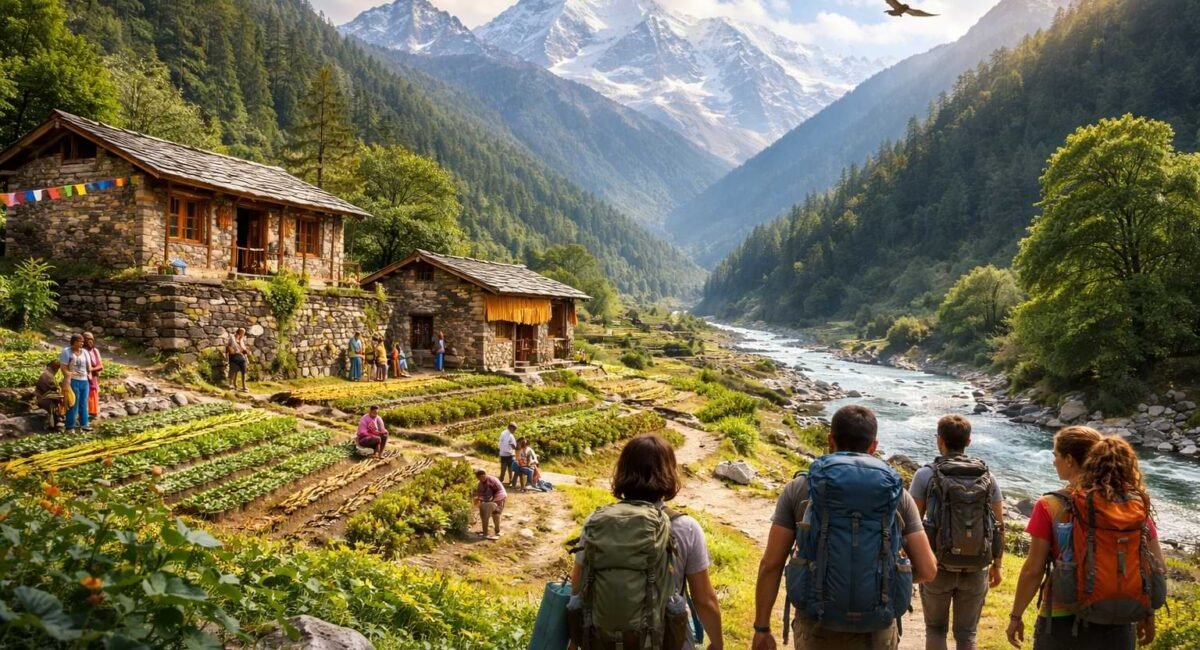
Why We Built EcoZyra: A Letter to the Traveller Who Wants to Do Better
This is not a startup story. It is a story about a mountain, its people, and a crisis that most visitors never see — written by someone who was born into it.
I grew up in the Himalayas.
Not as a metaphor. Not as a travel bio line. I mean that I opened my eyes to these mountains, drank water from these rivers, walked these forests, and grew up hearing the names of glaciers the way city children hear the names of streets. The Himalayas were not a destination for me. They were simply home.
So when I sit down to write this, I am not writing as a tech founder or a travel entrepreneur or a sustainability advocate — even though EcoZyra is all of those things. I am writing as someone who watched something I love begin to break, and who could not sit still and do nothing about it.
This is the story of why EcoZyra exists. And it is also a letter — to every traveller who has ever looked at the mountains and felt something they could not quite name. Something like responsibility.
“The mountains have given us everything. We have not always given them the same care in return.”
The Crisis Behind the Scenery
Every year, roughly 100 million people visit the Indian Himalayan Region. They come for the peaks, the pilgrimage routes, the fresh air, the adventure. They take photographs. They post them. And then, most of them leave.
What they leave behind is the part that does not make it into the photographs.
According to estimates by NITI Aayog and the World Bank, the Indian Himalayan Region now generates between five and eight million metric tonnes of solid waste every year. More than 60 percent of this waste is dumped, burned, or swept directly into rivers like the Ganga, Yamuna, and Alaknanda. The Himalayan Cleanup 2022 audit found that 92.7 percent of collected trash was plastic — and 72 percent of it was non-recyclable. Under the Swachh Bharat Mission, only 24 percent of waste generated across Himalayan states is being processed.
The trails we call beautiful are lined with plastic if you look closely enough. The rivers we call holy carry microplastics in their current. And the glaciers that feed those rivers — the ones that give us the Ganga, the Mandakini, the Bhagirathi — are disappearing faster than at any point in recorded history.
A landmark report by ISRO (Indian Space Research Organisation) found that approximately 75 percent of Himalayan glaciers are retreating at alarming rates. The International Centre for Integrated Mountain Development (ICIMOD) published findings showing that Himalayan glaciers disappeared 65 percent faster between 2010 and 2020 than in the previous decade, and could lose up to 75 percent of their total volume by 2100 if current emission trends continue. A study in Scientific Reports found that the rate of glacier mass loss today is ten times higher than it was during the seven centuries before 1975. ISRO’s analysis of the Bhilangna basin in Garhwal showed that the Khatling glacier alone receded 4,340 metres between 1965 and 2014 — losing ten percent of its total area. And according to NITI Aayog, nearly half of the natural springs in the Indian Himalayan Region are already drying up.
These are not abstract climate statistics. These are the water sources that villages in Uttarakhand have depended on for generations. When they go, the villages go with them.
The Villages That Are Already Going Quiet
There is a word people use in Uttarakhand for what is happening to the villages. Palayan. Migration. Departure. Leaving.
It is the defining crisis of our hills, and it rarely makes national headlines.
According to the 2011 Census of India, out of 16,793 villages in Uttarakhand, 1,055 were already uninhabited and another 405 had populations in single digits. Today, the state is estimated to have around 1,700 ghost villages — entire communities where the houses still stand but the people are gone.
An RTI filed by activist Hemant Gaunia revealed that over 500,000 people were forced to migrate out of Uttarakhand in just ten years, with 734 villages permanently abandoned. A study sponsored by the National Institute of Rural Development (NIRD) found that 50.2 percent of males in Uttarakhand have migrated out of the state. The Uttarakhand government was alarmed enough to constitute the Palayan Aayog (Migration Commission) in 2017 specifically to address this crisis.
The reason people leave is not complicated. There are no jobs in the villages. No digital infrastructure. No visible economic future. The young people — the ones who grew up climbing these hills, who know the names of every flower and the path of every stream — are leaving for Dehradun, Delhi, Pune, and Mumbai to work in factories, malls, and construction sites. They leave not because they want to, but because they see no other choice.
And when they leave, something more than just population goes with them. The folk songs stop being sung. The traditional farming knowledge stops being passed down. The terraced fields go back to jungle. The trails do not get cleared. The forests do not get tended.
This is what mass tourism has never fixed and will never fix on its own. When most of the tourist money flows to large hotel chains, national travel aggregators, and city-based tour operators — and very little reaches the actual village — the economic logic of leaving the mountains stays exactly the same.
The Problem With How We Currently Travel
I want to be honest here, because I think the travel industry — including a lot of the “eco-travel” space — has not been honest enough about this.
Uttarakhand is one of the most visited states in India. According to the World Bank’s mountain waste study, the state saw a 65 percent increase in tourist arrivals between 2006 and 2016 alone, with tourism contributing to over 50 percent of state GDP. Millions of pilgrims and tourists pass through every year for Char Dham, Kedarnath, Valley of Flowers, Chopta, Auli, Jim Corbett.
And yet the villages that sit next to these famous places remain economically fragile. The local taxi driver waits for a booking that may or may not come. The family running a small homestay struggles to be visible on any platform. The local trek guide — the one who grew up on these trails and knows them in every season — loses work to agencies from the plan areas that hire guides from outside the region.
The problem is not that people are coming to Uttarakhand. The problem is how the money moves when they do. Too much of it leaves the mountains without touching the communities that actually live there and protect them. The Himalayas are being used as a product — a backdrop for photographs, a pilgrimage point, a bucket-list adventure — while the people of the Himalayas watch others build businesses on the land their ancestors maintained.
I grew up watching this happen. And I knew, very specifically, what the alternative looked like — because I had seen it in small pockets, in individual homestays, in local guides who gave travellers an experience no resort could replicate. The problem was not a lack of quality. It was a lack of a platform.
“The Himalayas are being used as a product. We want to make them a home worth staying in.”
Why We Built EcoZyra
EcoZyra was built because of a simple, urgent conviction: the best way to save the Himalayas is to make it economically worthwhile for local communities to do so themselves.
Conservation imposed from the outside has never worked as well as conservation rooted in local ownership and the local economy. The family that runs an eco-homestay has every reason to keep the forest clean, the stream unpolluted, and the trail maintained — because their livelihood depends on it. The local trek leader who takes travellers through the high meadows of Himalays has every reason to educate them about the ecology they are walking through — because this land is not a product for him, it is his identity.
But these people need to be found. They need a platform. They need leads. And they need travellers who understand the difference between booking a room that happens to be in the mountains and actually travelling in a way that keeps the mountains alive.
EcoZyra is that platform. At its core, it is a listing and discovery service for eco-friendly local businesses in Uttarakhand — eco homestays, local tour guides, trek leaders, agro-tourism experiences, bird and wildlife guides, and local taxi services run by mountain-born drivers who know these roads as well as they know their own names. Every listing is a small business run by a local person. Every booking made through EcoZyra puts money directly into that person’s hands, not into a city-based intermediary.
Our categories were chosen deliberately. We are not trying to be a general travel platform. We are trying to be the most trusted and useful place on the internet for one very specific kind of travel — travel that is rooted in community, ecology, and genuine local experience.
The Four Things EcoZyra Stands For
1. Empowering local livelihoods. Every listing on EcoZyra is a local person building something where they were born. We help them get visible, get booked, and get fairly paid — so that staying in the mountains becomes a choice, not a sacrifice.
2. Promoting genuine eco-friendly travel. Not greenwashing. Not resorts that put a leaf logo on their brochure. We mean travel that actually reduces waste, supports conservation, and leaves the place better than it was found. We educate both travellers and providers on what this means in practice.
3. Preserving culture before it disappears. The folk songs of Garhwal, the Mandua rotis made by village women, the traditional knowledge of Himalayan medicinal plants, the architecture of stone-and-wood mountain homes — these things do not survive in museums. They survive when the communities that carry them have an economic reason to keep carrying them. Tourism, done right, is that reason.
4. Zero-footprint, clean Himalayas. We actively promote plastic-free travel. We support and feature events and providers that run clean-up drives. We believe that every traveller who comes to the mountains carries a responsibility — and we try to make it easy and natural for them to live up to it. The rivers, the trails, the high-altitude meadows, the glaciers — they all need us to make different choices.
What You Can Do
If you have read this far, you probably already feel some version of what we feel. You have been to the mountains, or you want to go. You have seen the waste on the trails, or heard about it. You want to travel in a way that gives more than it takes.
Here is how you can help — not abstractly, but specifically.
Stay local. When you visit Uttarakhand and other mountain areas, book a homestay in the village rather than a hotel in the nearest town. The difference in experience is enormous, and the difference in economic impact is even larger. Browse our listings at EcoZyra.com and you will find genuine, verified eco homestays run by local families across Rudraprayag, Chamoli, Pauri Garhwal, Tehri, and beyond.
Hire local. Your local trek guide was born on these trails. Your local taxi driver knows which roads flood in monsoon and which hairpin bends are tricky in winter. Choose them over city-based aggregators. You will have a better trip. They will have a livelihood.
Carry it out. Everything you bring into the mountains, bring back out. Your plastic bottles, your wrappers, your bags. The mountain has no waste management system equal to the scale of tourism it now receives. The responsibility sits, in part, with us.
Spread the word. If you know someone planning a trip to Uttarakhand, tell them about EcoZyra. Tell them about local homestays, local guides, local food. Every traveller we reach is a small shift in how the economy of these mountains works.
List your business. If you are a local service provider in Uttarakhand or any other Himalayan region — a homestay owner, a guide, a trek leader, a farmer running agro-tourism — list your business on EcoZyra for free. This platform was built for you. Your livelihood is the whole point of it.
A Final Thought
The glaciers of the Himalayas or Garhwal are not going to be saved by any single platform or any single traveller making better choices. The migration crisis in Uttarakhand’s villages is not going to be solved by one website. These are large, structural problems that require government action, community leadership, and generational change.
But here is what I know from growing up in these mountains: they are still here. The forests are still standing in the places where communities have fought to protect them. The springs that dry up in neglected areas still flow in the villages where people maintain the tree cover around them. The folk songs are still being sung by the old women in Sari village and the young men in the bands that carry them forward. The culture is not dead — it is just waiting for the conditions to keep living.
EcoZyra is an attempt to create some of those conditions. To build a bridge between the traveller who wants to do better and the local community that deserves better. To make the Himalayas worth staying in, worth investing in, and worth protecting — not as a charity project, but as a living economy.
We are early. We are small. But we are building something real, with real people, in the real mountains.
We would be honoured if you were part of it.
— EcoZyra Team, Uttarakhand
| Sources & References 1. ISRO — Monitoring Snow and Glaciers of Himalayan Region: indiascienceandtechnology.gov.in 2. ICIMOD — Hindu Kush Himalaya Assessment Report 2023 (via Al Jazeera): aljazeera.com 3. Nature / Scientific Reports — Accelerated Mass Loss of Himalayan Glaciers: nature.com 4. ORF — Retreating Glaciers and Water Flows in the Himalayas: orfonline.org 5. NITI Aayog & World Bank — Solid Waste Management in Mountain Areas: documents1.worldbank.org 6. IDR Online — Why the Himalayas Are Drowning in Waste: idronline.org 7. Down to Earth — Plastic Pollution Crisis in Himalayan Region 2024: downtoearth.org.in 8. PMC / Indian Journal of Labour Economics — Forced Out-Migration from Uttarakhand: pmc.ncbi.nlm.nih.gov 9. NIRD — Out-Migration from Hill Region of Uttarakhand: nirdpr.org.in 10. Organiser — Migration from Uttarakhand: A Public Policy Issue: organiser.org 11. Census of India 2011 (via research literature): censusindia.gov.in 12. National Green Tribunal / MoEF&CC — Tourism and Environment in IHR: greentribunal.gov.in 13. Press Insider — Restoring the Himalayas, One Plastic Wrapper at a Time: pressinsider.com |
Leave a Review
There are no reviews yet. Be the first one to write one.