
Birds of Garhwal: A Beginner’s Guide to Birdwatching in Uttarakhand
You have walked these forests and seen the peaks. But have you really looked at what lives in them? Here is your honest, practical guide to one of the most rewarding wildlife experiences in India.
There is a moment that catches you off guard.
You are walking a forest trail somewhere in the Garhwal hills – maybe near Chopta, maybe along the Mandakini river at first light, maybe through the oak woods above Devalsari. The morning is quiet, the air is cold, and you are not really looking for anything. And then, out of the canopy above you, comes a sound that makes you stop completely.
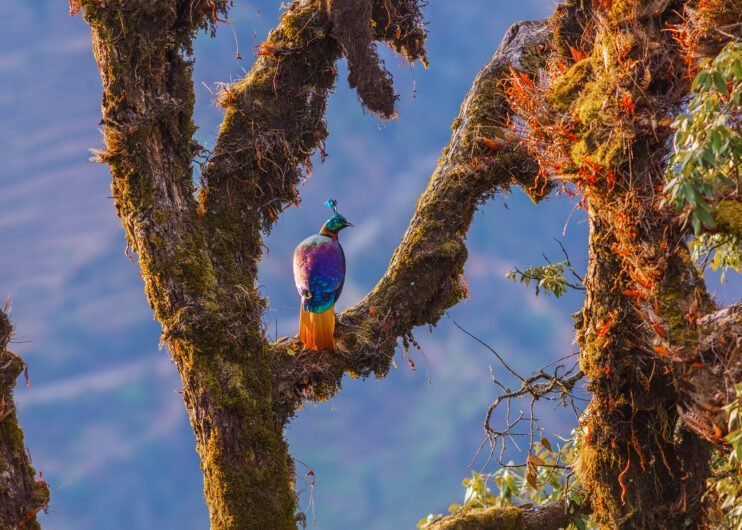
It could be the clear, flute-like whistle of a Blue Whistling Thrush carrying up from the stream below. Or the enormous, echoing call of a Great Barbet somewhere in the rhododendrons above. Or – if your altitude and your timing and your luck are all aligned – the unmistakable flash of iridescent copper, green, and purple in the undergrowth that tells you a male Himalayan Monal has just crossed your path.
That is the moment birders in Garhwal come back for, year after year. Not because they are experts with expensive equipment. But because these forests reward attention in a way that is genuinely hard to find anywhere else.
Garhwal is one of the finest birdwatching destinations in all of Asia. The Wildlife Institute of India (WII) – an autonomous research institute under the Government of India’s Ministry of Environment, Forest and Climate Change – has documented over 240 bird species in the Kedarnath Wildlife Sanctuary alone, which covers the Chopta-Tungnath-Rudranath corridor that runs through Rudraprayag and Chamoli districts. The entire Nanda Devi Biosphere Reserve, as noted by the UNESCO World Heritage Centre, falls within the Western Himalayas Endemic Bird Area – a globally recognised region of extraordinary avian diversity, home to seven restricted-range bird species found nowhere else on Earth.
If you have never been birdwatching before, Garhwal is one of the best places in the world to begin. This guide is written to help you find the birds, understand them, and experience them in a way that actually benefits the forests and the communities that protect them.
“In Garhwal, the birds do not wait for you to notice them. They announce themselves — if you have learned to listen.”
Why Garhwal Has So Many Birds
The short answer is altitude. Uttarakhand as a whole records more than 700 bird species — a figure that places it among the most bird-rich states in India — and a substantial portion of those species are found across the Garhwal hills.
The Garhwal Himalayas climb from around 300 metres above sea level near Haridwar and Rishikesh all the way to the glacial peaks above 7,000 metres. That extreme vertical range — compressed into a relatively short distance — creates a remarkable stack of completely different habitats, one layered above the next, each with its own distinct bird community.
In the lowest foothills, near the Shivalik range and the Rajaji National Park corridor, you have subtropical and riverine forests with hornbills, kingfishers, and large raptors. As you climb into the mid-altitude belt of oak, rhododendron, and deodar forest between 1,500 and 3,000 metres — the zone where most of Garhwal’s villages and valleys sit — you enter pheasant and flycatcher country. Above the treeline, in the alpine meadows and rocky slopes above 3,500 metres, specialist high-altitude species take over: snow partridges, accentors, rosefinches, and the Himalayan Monal.
This vertical diversity is why a single day’s drive through Garhwal can take a birder through multiple completely different bird communities. It is genuinely rare in the world to have this kind of layered richness within such a small geographical area.
The UNESCO World Heritage listing for the Nanda Devi and Valley of Flowers National Parks specifically recognises this region’s importance, noting that the entire Nanda Devi Biosphere Reserve lies within the Western Himalayas Endemic Bird Area and supports seven restricted-range species that are endemic to this specific zone. The Uttarakhand Forest Department confirms that the Valley of Flowers National Park alone hosts diverse high-altitude birdlife within its 87.5 square kilometres of alpine ecosystem.
Six Birds Every Garhwal Visitor Should Know
Garhwal has hundreds of birds worth learning. But there are a handful that define the experience — the ones you will talk about for years and that local guides spend their lives understanding.
| Himalayan Monal · Lophophorus impejanus Conservation status: Least Concern — IUCN Red List | State Bird of Uttarakhand No description does a male Monal justice until you have seen one. Nine distinct colours on a single bird — iridescent green, copper, purple, white, rufous — arranged with impossible precision. It is Uttarakhand’s state bird, and also the national bird of Nepal. The IUCN Red List classifies it as Least Concern overall, but its population is declining, largely due to poaching for its distinctive crest feathers and habitat disturbance from hydroelectric development. The WII notes it as one of the key species of the Kedarnath Wildlife Sanctuary. The male digs through snow with its curved bill to find tubers and roots during winter. It is most visible in early morning on open slopes between 2,400 and 4,500 metres. Where to spot: Chopta meadows, Tungnath trail, Chandrashila summit slopes, high-altitude terrain in Kedarnath Wildlife Sanctuary |
| Western Tragopan · Tragopan melanocephalus Conservation status: Vulnerable — IUCN Red List | Schedule I, Wildlife Protection Act 1972 If the Monal is the showpiece, the Western Tragopan is the treasure. The Central Zoo Authority of India and the Wildlife Institute of India, in their jointly published National Studbook, confirm it is listed as Vulnerable on the IUCN Red List and under Schedule I of India’s Wildlife Protection Act, 1972 — the highest level of legal protection. Its global population is estimated at between 2,500 and 3,500 individuals, making it one of the rarest pheasants on Earth. CITES lists it under Appendix I. The male has a velvet-black head, crimson breast, white spotting, and brilliant blue-orange facial wattles that inflate during courtship. In Garhwal, it calls — a loud, repeated wailing sound during breeding season — but almost never shows itself. Finding one requires patience, a local guide who knows the territory, and a great deal of good fortune. Where to spot: Dense oak-conifer forest above 2,400 metres in Kedarnath Wildlife Sanctuary — rarely seen, occasionally heard near Tungnath and upper Chopta belt |
| Blue Whistling Thrush · Myophonus caeruleus Conservation status: Least Concern — IUCN Red ListThe sound before the sighting: a rich, melodious whistling that carries up from mossy boulders and river gorges. The bird itself is deep cobalt blue — almost black in shadow — with small white spots on the wings. It haunts fast-flowing mountain streams and is one of the most reliably present birds in Garhwal’s mid-altitude forests. Beginners love it because it is visible, its call is unforgettable, and it tends to sit in the open on midstream rocks where you can observe it for a long time. It is also one of those birds that, once you have learned its call, you will hear everywhere in Garhwal and never again have to wonder what it is. Where to spot: Any rocky stream or river in Garhwal — riverbanks near Sari village, the Mandakini river, Chopta forest trails near water |
| Brown Dipper · Cinclus pallasii Conservation status: Least Concern — IUCN Red List A small, round, uniformly dark-brown bird that walks directly into fast-flowing Himalayan rivers and streams to hunt for invertebrates underwater. Not a duck, not a wader — a songbird that has evolved the ability to swim and dive in mountain rivers. It bobs up and down constantly while standing on midstream boulders, as if nodding to itself, and then plunges in without hesitation. It is one of the most extraordinary birds in the world by behaviour, and it is common throughout Garhwal’s river systems. Once you know what to look for, you will spot it on almost every walk near a mountain stream. Where to spot: Fast-flowing streams and rivers throughout Garhwal — streams near Ukhimath, the Bhilangna river, streams feeding into Deoria Tal |
| Great Barbet · Psilopogon virens Conservation status: Least Concern — IUCN Red List Asia’s largest barbet, and the bird most likely to be heard before any other species on a Garhwal forest morning. Its call is enormous — a loud, repeated, reverberating note that carries astonishing distances through the oak and rhododendron forests between 1,500 and 3,000 metres. The bird itself has a massive yellow-green bill, a dark blue head, green back, and a brown belly. Beginners who hear it for the first time often cannot believe that such a large sound comes from a single bird. It is one of the signature sounds of Garhwal’s mid-altitude forests and one of the first birds a new birder in the region will learn to identify. Where to spot: Oak and rhododendron forest throughout Garhwal — Devalsari, Chopta approaches, Pauri Garhwal forests, the Aglar Valley |
| Himalayan Griffon Vulture · Gyps himalayensis Conservation status: Least Concern — IUCN Red List With a wingspan that can exceed 2.6 metres, the Himalayan Griffon is one of the largest birds in the world and a dramatic presence in Garhwal’s skies. It rides thermal currents above high ridges, barely moving its wings for minutes at a time, and plays a critical ecological role as the primary scavenger of the high Himalayas. Watching a group of Griffons circling in slow spirals above a Garhwal ridgeline at midday — catching thermals above the snowline — is one of the great mountain wildlife experiences, completely free, accessible from any high viewpoint, and requiring no specialist knowledge to enjoy. Where to spot: High ridges and open slopes throughout Garhwal — visible from Chopta, Tungnath, Chandrashila, and most high-altitude viewpoints |
Where to Go: The Best Birding Areas in Garhwal
Chopta and the Kedarnath Wildlife Sanctuary
This is where most serious birders begin, and many never feel the need to go anywhere else. The Kedarnath Wildlife Sanctuary, managed by the Uttarakhand Forest Department and studied extensively by the Wildlife Institute of India, covers 975.2 square kilometres of Rudraprayag and Chamoli districts and has recorded over 240 bird species within its boundaries. It spans an altitude range from 1,160 metres near Phata all the way to the Chaukhamba peak at 7,068 metres — which means that within a single sanctuary, you can bird across multiple entirely different ecosystems. The trail from Chopta to Tungnath is particularly productive: the treeline here sits at around 3,500 metres, and the meadows above it are classic Monal territory from March through June.
Several eco homestays in Sari village — listed on EcoZyra — are ideally placed as early-morning birding bases. Sari sits at around 2,000 metres, right in the heart of the mid-altitude forest zone, and the 3-kilometre trail up to Deoria Tal passes through excellent mixed forest that produces a very consistent list of species.
One person who knows this valley better than most is Yashpal Negi of Makkumath village, a bird specialist who has been guiding birdwatchers in the Tungnath valley for over 20 years. Yashpal can identify a species from its call alone — before it is ever seen. He runs a homestay in Makku village and has watched the pressures on Chopta-Tungnath grow steadily over the years. His observation is straightforward: the area needs tourists to be redirected from the central corridor into the surrounding villages, and homestays are the most effective way to do that. The Tungnath valley, in his words, is a paradise for birdwatchers, and it draws large numbers of nature lovers every year — but that attention must be managed carefully if the birds are to remain.
The Nanda Devi Biosphere Reserve — Valley of Flowers and Hemkund
The Valley of Flowers National Park is a UNESCO World Heritage Site jointly inscribed with Nanda Devi National Park. The UNESCO citation specifically notes that the entire Nanda Devi Biosphere Reserve lies within the Western Himalayas Endemic Bird Area, with seven restricted-range bird species endemic to this zone. The Uttarakhand Forest Department confirms the park is administered by the state forestry department under the national Ministry of Environment, Forest and Climate Change. At 3,352 to 3,658 metres above sea level, the valley’s alpine meadow habitat is completely different from the forest zones of lower Garhwal. Himalayan Monals are present, along with Snow Pigeons, Red-billed Choughs, and a range of high-altitude specialists. The approach trek from Govindghat passes through excellent lower-altitude forest birding as well.
Devalsari and the Aglar Valley, Tehri Garhwal
The Aglar Valley in Tehri Garhwal district is one of Garhwal’s most productive birding areas and one of its least crowded. The mix of agricultural fields, deodar forest, and broad-leaved slopes at around 1,500 to 2,500 metres creates a remarkable variety of habitat in a small area. This region has been identified as an Important Bird Area (IBA) by BirdLife International. Bird specialities include Wallcreepers on the rock faces above the valley, a range of warblers and flycatchers in the forest, and excellent raptor watching from the open ridges. EcoZyra lists eco homestays in Devalsari village — local stays that put you directly inside this landscape at the right time of day.
Khirsu, Pauri Garhwal
Pauri Garhwal is consistently underrated as a birding district. Khirsu, just 17 kilometres from Pauri town, offers some of the best accessible forest birding in the district — oak and deodar stands with direct views of the high peaks of the Garhwal range. The Peacock Homestay at Khirsu Range, listed on EcoZyra, is ideally situated for birders who want to explore this area seriously. The best birding windows are March to June and September to November.
The Best Time to Go Birding in Garhwal
Every season has something to offer, but two windows are outstanding.
March to May is the season most experienced birders prefer. The Himalayan Monal and other pheasants are in breeding plumage and are far more active and visible than at other times of year. Rhododendrons are flowering — drawing sunbirds, flowerpeckers, and barbets to the forest edges in large numbers. The forests fill with birdsong from before dawn until mid-morning. If you want to see a Monal in full iridescent glory, a March or April morning on the Chopta trail is where you come.
October to February is excellent for the lower and mid-altitude zones. The partial leaf fall from October onwards makes birds much more visible in the forest canopy. Migratory species arrive from Central Asia and higher elevations — raptors, flycatchers, and winter thrushes that are not present in summer. Clear skies and stable weather make photography easier. Note that high-altitude areas above 3,000 metres will be cold and some trails snow-covered from December onwards.
June to September is the monsoon. The high-altitude trails are lush and the Valley of Flowers is at peak bloom, but lower trails can be slippery and dense vegetation makes spotting harder. The Kedarnath Wildlife Sanctuary’s visiting season runs from April to June and September to November, as noted by the Wildlife Institute of India. For beginners, this season is best enjoyed with a local guide who knows safe, productive routes.
What You Actually Need to Start
The barrier to entry for birdwatching is much lower than most people think. You need three things.
Binoculars. This is the one genuine investment worth making. A pair of 8×42 binoculars in the ₹4,000–₹10,000 range is more than adequate for Garhwal’s forests. The key specifications to look for are field of view (wider is better for following moving birds in dense forest) and light transmission (important for low-light forest conditions at dawn). You do not need to spend more than this to have an excellent experience.
A field guide. Birds of the Indian Subcontinent by Grimmett, Inskipp, and Inskipp is the standard reference book. For digital use, eBird by the Cornell Lab of Ornithology is free, works offline, covers the entire Indian Himalayan Region with accurate species lists for specific locations, and allows you to contribute your sightings to a global scientific database at the same time. Every sighting you record in Garhwal adds to the scientific record of these bird populations.
Quiet, muted clothing. This is not about having a special kit. It is simply about not wearing bright colours that startle birds before you can observe them. Greens, browns, and greys work. Comfortable waterproof footwear matters more than anything else — Garhwal’s trails are often damp.
Why You Should Bird with a Local Guide
There are two versions of birdwatching in Garhwal. In the first version, you walk a trail with a field guide, trying to match what you half-glimpsed in the canopy to a plate in a book. You will see some birds this way. You will miss far more.
In the second version, you walk with someone who has been in these specific forests since childhood. Someone who knows that the Monal feeds on the north-facing slope above the second stream crossing in early morning. Someone who can distinguish a Koklass Pheasant from a Kalij by a single note of their respective calls heard through 200 metres of dense forest. Someone who reads the forest — a sudden silence, a movement in the undergrowth, the alarm call of a small warbler — and can tell you instantly what it means.
Local birding guides in Garhwal are not just service providers. They are living reference libraries of the ecosystems they grew up inside. No visiting birder, however expert, will ever match the knowledge that comes from a lifetime of walking the same forests in every season.
Hiring a local guide also directly supports the economic logic of forest conservation. When local people earn their livelihood from showing the forest intact and alive, the forest stays intact and alive. This is not sentiment — it is the single most effective mechanism for keeping biodiversity healthy in any part of the world.
EcoZyra lists local birds and wildlife guides in Garhwal — among them Praveen Kewalram Purohit of Rudraprayag, one of the most respected local bird guides in the Chopta-Kedarnath belt. Another is Yashpal Negi of Makkumath village — a bird specialist with over two decades of experience in the Tungnath valley, whose ability to identify species by call alone sets him apart. These are people born in these hills who have spent years developing genuine expertise in the birds and habitats of their home region.
“The best bird guide in Garhwal is not the one with the most certificates. It is the one who grew up listening to these forests.”
How to Bird Responsibly in Garhwal
Birdwatching done thoughtlessly can harm the very thing you came to see. Here are the principles that matter most.
Keep your group small. Two to four people are ideal for forest birding. Large groups are inevitably noisier and slower. A pair of birders will consistently outperform any group of twelve.
Never play recordings to attract birds. Using a speaker to broadcast a bird’s territorial call and draw it in is increasingly common and genuinely harmful. Birds respond to recordings by becoming agitated, burning energy on a territorial threat that does not exist, and sometimes abandoning nest sites. It is not worth the sighting.
Be aware of helicopter corridors during the breeding season. The breeding season for most Himalayan birds runs from March through June. This overlaps almost exactly with the Char Dham Yatra season, which begins in late April and brings a sharp increase in helicopter traffic across the Garhwal hills. Yashpal Negi, a bird specialist from Makkumath who has guided birdwatchers in the Tungnath valley for over 20 years, notes that helicopter noise is now among the most immediate threats to the region’s sensitive species. When disturbed during the nesting period, birds abandon their nests. Plan your visits accordingly — early mornings before the helicopter corridors open, and trails away from the main pilgrimage routes, consistently produce better birding and cause less disturbance.
Stay on the trail. Garhwal’s forest understory — the leaf litter, the root systems, the small plants — is where many ground-nesting species breed. Off-trail foot traffic damages this layer quickly and cumulatively.
Carry all waste out. The trails you bird on are habitats. Every piece of plastic left behind is a physical and chemical hazard for birds and other wildlife. Leave nothing.
Stay in a local eco homestay. This is genuinely part of responsible birding, not just good travel advice. The families running homestays in Garhwal’s forest villages are the people who actually protect these habitats every day. When your spending stays in the village, the economic value of the intact forest stays in the village too. Browse verified eco homestays near Garhwal’s best birding zones on EcoZyra.
Your First Birding Morning in Garhwal
You do not need a dedicated birdwatching trip. You just need to be somewhere in the Garhwal hills — a homestay in Sari, a room in Ukhimath, a tent in the Chopta meadows — set your alarm for 5.30am, and step outside before the day fully arrives.
Stand still for ten minutes. Let your eyes adjust. Let the forest register that you are not a threat. Then listen.
The Blue Whistling Thrush will announce itself from the stream below, confident and musical. The Great Barbet will start its call from somewhere in the canopy above — repetitive, authoritative, and impossible to ignore. If there is a meadow nearby and you are at the right altitude, and if you are very quiet, a Monal might step out from the treeline onto the open slope to feed in the early light. Nine colours in the first sun of the Himalayan morning.
That is the moment. That is what these forests can give you if you come prepared and come with care.
At EcoZyra, we built this platform so that when you come for that moment, the guide who finds it with you was born in these mountains. The bed you slept in belongs to a family that has protected this valley for generations. And the money you leave behind helps ensure that these forests — and the birds in them — are here the next time you come.
Browse local birding guides, eco homestays, and wildlife experiences across Garhwal at EcoZyra.com.
| Sources & References — Government, International Organisations & Scientific Authorities Only 1. Wildlife Institute of India (WII), Govt. of India — Kedarnath Wildlife Sanctuary: wii.gov.in 2. UNESCO World Heritage Centre — Nanda Devi and Valley of Flowers National Parks: whc.unesco.org/en/list/335 3. Uttarakhand Forest Department, Govt. of Uttarakhand — Valley of Flowers National Park: forest.uk.gov.in 4. Central Zoo Authority (CZA) & Wildlife Institute of India — National Studbook of Western Tragopan: cza.nic.in 5. IUCN Red List of Threatened Species — Himalayan Monal (Lophophorus impejanus): iucnredlist.org 6. IUCN Red List of Threatened Species — Western Tragopan (Tragopan melanocephalus): iucnredlist.org 7. BirdLife International — Important Bird and Biodiversity Areas (IBAs): birdlife.org 8. Cornell Lab of Ornithology — eBird India Species Checklists: ebird.org/india 9. Himachal Pradesh Forest Department — Western Tragopan Conservation Report: hpforest.gov.in 10. Ministry of Environment, Forest and Climate Change (MoEF&CC), Govt. of India — National Parks data: moef.gov.in |
Leave a Review
There are no reviews yet. Be the first one to write one.