How to Identify a Genuinely Eco-Friendly Homestay (vs Greenwashing)
Every mountain homestay these days calls itself ‘eco-friendly.’ Most of them are not. Here is the honest, practical guide to telling the difference — before you book.
Here is something worth knowing before your next mountain trip.
The word ‘eco-friendly’ has no legal definition in India’s tourism sector. Anyone can put it on a website. Anyone can print it on a brochure. A homestay surrounded by plastic waste can call itself eco-friendly. A concrete resort that pumps untreated wastewater into a river can describe itself as sustainable. And unless you know what to actually look for, it is very easy to spend good money thinking you are doing the right thing when you are not.
This is not a new problem. The term ‘greenwashing’ was coined in 1986 by New York environmentalist Jay Westervelt, and significantly, it originated from the tourism industry itself. He wrote an essay about a hotel that placed cards in guest rooms encouraging towel reuse to ‘save the environment,’ while making no meaningful effort to reduce its actual energy or water consumption. The goal, he noted, was not environmental protection. It was reducing laundry costs while appearing responsible. That was 1986. Nearly four decades later, the same pattern plays out daily across thousands of mountain homestays, trekking lodges, and hill stations across India.
A 2020 study commissioned by the European Commission found that over 53 percent of green claims made by companies across sectors were vague, misleading, or entirely unfounded — and a further 40 percent were unsubstantiated, with no evidence to support them. The tourism and hospitality sector is among the most affected.
This guide is written to give you a practical, honest framework for identifying the real thing. Not to make you suspicious of every homestay you consider — but to make you a smarter, more informed traveller who can recognise genuine commitment when you see it, and walk away from marketing spin when you encounter it.
“Eco-friendly” is not a certification. It is not a legal standard. It is a description that anyone can use, about anything. The question is what lies behind it.
What ‘Eco-Friendly’ Should Actually Mean
Before getting into how to spot greenwashing, it helps to be clear about what genuine eco-friendly tourism actually is — not as a marketing phrase, but as a standard.
The United Nations World Tourism Organization (now known as UN Tourism) defines sustainable tourism as tourism that takes full account of its current and future economic, social, and environmental impacts — addressing the needs of visitors, the industry, the environment, and host communities. That definition has three components that matter equally: environmental responsibility, economic sustainability, and community benefit. Take away any one of the three, and what you have left is not sustainable tourism — it is just a holiday with a leaf logo.
The Global Sustainable Tourism Council (GSTC) — established in 2007 by a coalition that includes the United Nations Environment Programme (UNEP), the United Nations Foundation, and the UN World Tourism Organization — manages the most widely recognised global standards for sustainable tourism. The GSTC organises its standards around four pillars: Sustainable Management, Socioeconomic impacts, Cultural impacts, and Environmental impacts. Notice that the environment is one of four pillars — not the only one. A homestay that installs one solar panel but exploits cheap local labour, dumps waste in the nearby stream, and sources nothing from local farmers is not genuinely eco-friendly. It just has a solar panel.
In India specifically, the Ministry of Tourism, Government of India launched the National Strategy for Sustainable Tourism in partnership with UNEP and the Responsible Tourism Society of India. This strategy identifies six pillars for sustainable tourism development in India: environmental sustainability, biodiversity protection, economic sustainability, socio-cultural sustainability, certification, and capacity building. The Ministry’s Sustainable Tourism Criteria for India (STCI), launched in August 2014, explicitly covers accommodation units, including homestays, requiring measures such as rainwater harvesting, sewage treatment, waste management, energy conservation, non-CFC equipment, and community benefit. That is a government-defined standard. Very few homestays in India are actually certified to it.
So when you see ‘eco-friendly’ on a homestay listing, the question to ask is not whether they have used the words correctly. The question is which of these pillars they are actually living up to — and which ones they are quietly ignoring.
The Seven Signs of Greenwashing
These are the patterns that come up again and again. Learn to spot them and you will save yourself a lot of disappointment — and stop funding operations that do more harm than good.
1. Vague language with nothing behind it
The most common form of greenwashing in tourism is the use of words like ‘eco-friendly,’ ‘green,’ ‘natural,’ ‘sustainable,’ ‘responsible,’ or ‘nature-friendly’ with absolutely no explanation of what they mean in practice. Look at the homepage. Look at the listing description. If you see these words but find no specific practices described — no mention of how waste is managed, where food is sourced, what the water system is, how energy is generated — that vagueness is itself a red flag. Genuine eco-friendly operations are specific. They tell you exactly what they do, because they are proud of it and have worked hard for it.
2. A single green feature presented as an identity
This is the towel card problem that Jay Westervelt wrote about in 1986, updated for modern India. A homestay might proudly mention that it uses solar lights. Or that it serves local food. Or that it has plants on the terrace. One genuine practice, presented as if it defines the entire operation. Genuine eco-friendliness is systemic, not decorative. It means the whole operation — waste, water, energy, food sourcing, waste disposal, employment practices, community relationships — has been considered and managed. One solar light does not make an eco homestay.
3. No visible waste management system
This is the single most reliable indicator you have when you physically arrive at a homestay. How is waste handled? Is there a system for separating dry and wet waste? Is plastic waste collected and taken for proper disposal? Or is it burned in the backyard, dumped down the hillside, or left in an open pit behind the property? According to NITI Aayog research on India’s homestay sector, waste management remains one of the most significant operational gaps across mountain homestays nationally. A homestay that claims to be eco-friendly but has no visible, working waste system is greenwashing by definition.
4. No sourcing from the local community or farmers
This one matters enormously in Uttarakhand, and it is easy to check. Does the food served come from local farmers and village producers? Does the homestay employ people from the local village? Are any of the services — guides, taxis, activities — sourced locally? UN Tourism’s definition of sustainable tourism explicitly includes economic benefit to host communities. A homestay that imports all its supplies from a city distributor, employs staff from outside the district, and sends all its profits back to an urban owner is not community-based eco-tourism. It is an extraction operation with a green coat of paint.
5. Certification claims that do not check out
Some greenwashing goes beyond vague language into outright fabrication of credentials. You may see logos, badges, or claims of certification from bodies that are either completely invented or entirely unrecognised. The GSTC maintains a public database of accredited certification bodies and GSTC-recognised standards. If a homestay claims eco-certification, it is entirely reasonable to ask which body certified them and to look that body up. In India, the Ministry of Tourism’s STCI framework and the state-level certification schemes are the recognised standards. Certification from an unknown entity with no verifiable track record should be treated with scepticism.
6. Plastic everywhere, despite the claims
This is the most visible and immediate test you can do. Walk into any room, bathroom, kitchen, or outdoor area of the property. Plastic bottles for drinking water? Single-use plastic toiletries? Are plastic bags used routinely? Polythene in the garden? A genuinely eco-friendly homestay in the Himalayan region understands what plastic waste does to mountain rivers and forests. It invests in steel or copper water vessels, ceramic dispensers, and cloth or jute alternatives. The presence of avoidable single-use plastic is direct evidence that environmental claims are not matched by operational reality.
7. No transparency when you ask questions
This is the most direct test of all, and it works every time. Ask. Before you book, write to the homestay and ask specific questions: How is your waste managed? Where does your food come from? Are your staff from the local village? Do you have any sustainability certifications? A genuinely committed operation will answer these questions with enthusiasm and specifics. They will be proud of what they have built and will want you to understand it. An operation that is greenwashing will either ignore the question, respond with more vague language, or become defensive. The response tells you everything you need to know.
What a Genuinely Eco-Friendly Homestay Actually Looks Like
Now for the other side of the coin. Because genuine eco-friendly homestays do exist. They are not rare. They are just less visible than the ones spending money on marketing. Here is what to look for.
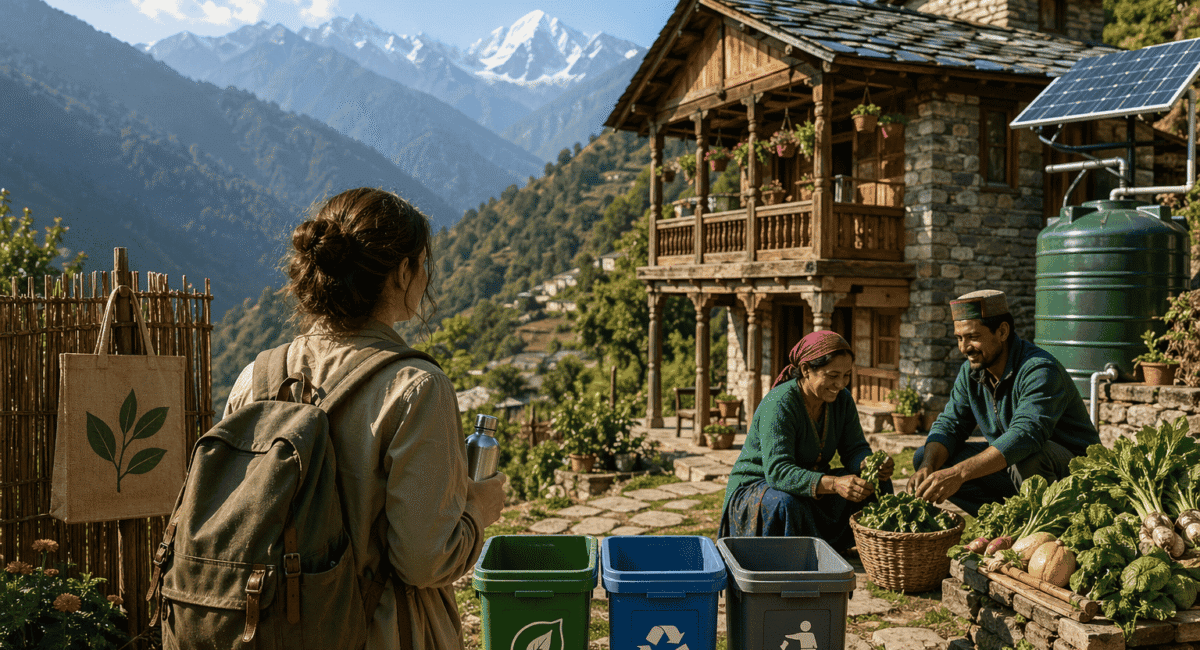
| What genuine looks like: Waste management → Separate bins for wet waste, dry waste, and plastic — visibly used by all staff → Plastic waste collected and transported to a recycling facility or NGO collection point → Composting of kitchen and garden waste — often used in the kitchen garden → No open burning of waste on the property → Guests are actively asked not to bring single-use plastic onto the property |
| What genuine looks like: Water and energy → Rainwater harvesting system on the roof or in the garden — visible and functional → Solar panels for water heating or electricity — and staff can explain the system → Low-flow taps and showers; guests are asked to be mindful of water use → No swimming pool or decorative water features in a water-scarce mountain location → Energy-efficient LED lighting throughout the property |
| What genuine looks like: Community and food → Food sourced from local farmers — and the homestay owner can name them → Traditional Garhwali or Kumaoni dishes served — using local millets, vegetables, and dairy → Staff hired from the local village or nearby communities → Guides, taxi services, and activity providers recommended are local people → Profits remain within the village economy rather than flowing to an absentee owner |
| What genuine looks like: Culture and environment → The building uses local materials and traditional architecture where possible → The property does not disturb the surrounding forest, stream, or agricultural land → Wildlife is never disturbed, fed, or exploited for entertainment → Guests are educated — gently, respectfully — about the local ecosystem and culture → The homestay owner can speak to you about what conservation means in their specific valley |
The Question Every Traveller Should Ask Before Booking
You do not need to be an environmental expert to verify any of this. You just need to ask the right question.
Before booking any homestay that describes itself as eco-friendly — whether in the Himalayas or anywhere else in India — send one message with these four questions:
One: How do you handle waste, including plastic, wet kitchen waste, and dry waste?
Two: Do you source food from local farmers? Can you tell me who?
Three: Are the people who work at your homestay from the local village?
Four: Do you have any sustainability certifications, and if so, from which body?
The quality and specificity of the answers you receive will tell you more than any logo or label on the website. Authentic eco-friendly operators — the ones who have genuinely built something worth supporting — almost always respond to these questions with warmth and detail. They want you to understand what they have built, because it is the work they are most proud of.
If you receive a non-answer, a deflection, or a copy-paste response that restates the original marketing claims without engaging with your specific questions, you have your answer.
Why This Matters More in the Himalayas
Greenwashing is a problem everywhere. But in mountain ecosystems like Garhwal and Kumaon, the stakes are higher than in most places.
The Indian Himalayan Region is one of the most ecologically fragile landscapes on Earth. Glaciers are retreating. Springs are drying up. Forests are under pressure from tourism infrastructure. Rivers that have been clean for centuries are beginning to carry plastic from tourist corridors. And the local communities who have lived in and maintained these ecosystems for generations are being economically squeezed out by outside operators who market their services using the mountains’ natural beauty without giving anything meaningful back.
A 2025 NITI Aayog report on India’s homestay sector found that 94 percent of Indian travellers actively seek eco-friendly travel options, and 72 percent say they prioritise supporting local communities when they travel. That is an enormous majority, and it represents an enormous responsibility on the part of travel platforms and homestay operators to be honest about what they are actually offering.
The same report found that the homestay sector, when genuinely community-based, has an employment multiplier of 4.38 — meaning that every unit of income generated by a local homestay creates cascading economic benefit across the surrounding community: farmers, artisans, guides, drivers, and local food producers. That is the positive loop that genuine eco-friendly tourism creates. Greenwashing breaks that loop by capturing the economic value of the ‘eco’ label while sending the money elsewhere.
When you choose a genuinely eco-friendly homestay in Uttarakhand, you are doing three things at once. You are protecting a mountain ecosystem by supporting an operation that treats it responsibly. You are putting money directly into the hands of a local family that has chosen to stay in their village rather than migrate. And you are proving, with your spending, that honest sustainable tourism is more valuable than imitation.
“The best way to fight greenwashing is not outrage. It is knowledge. Know what you are looking for. Ask the right questions. And when you find the real thing, stay there.”
How EcoZyra Approaches This
This is a question we take seriously at EcoZyra, because our entire purpose is built on the answer.
Every listing on EcoZyra represents a local business — a small homestay run by a Garhwali family, a trek guide born in the Rudraprayag hills, an agro-tourism farm in a Chamoli village. We do not list corporate properties. We do not list operations whose owners live in cities and manage mountain properties remotely. We list the people who are genuinely from these mountains and have built something of genuine value within them.
We believe in transparency over certification claims. We do not display a green badge and leave you to trust it. We encourage every traveller to ask the questions above, to read the listing descriptions carefully, and to contact hosts directly before booking. A genuine local host will always welcome that contact. They want you to understand what they have built.
The Ministry of Tourism’s roadmap for sustainable homestay tourism in India specifically notes that Uttarakhand follows a structured, phase-wise incentive programme for homestay development tailored to the needs of both hilly and plain regions. EcoZyra’s listings in Garhwal are the ground-level expression of exactly what that policy envisions — local families, local economy, genuine ecological care, and authentic cultural experience.
We are building this platform because we believe that travellers who care about the Himalayas deserve a way to find the operators who actually care for them. Not just in their marketing language. In their daily operations, their waste systems, their food sourcing, their community relationships, and their willingness to answer your questions honestly.
Browse verified local eco homestays, birding guides, trek leaders, and agro-tourism experiences across Garhwal and Uttarakhand at EcoZyra.com. And the next time a listing calls itself eco-friendly, you know exactly what to ask.
EcoZyra Team, Uttarakhand
Frequently Asked Questions
What is greenwashing in tourism?
Greenwashing in tourism is when a property, tour operator, or destination uses misleading marketing language to appear eco-friendly or sustainable without making genuine operational changes. It can range from vague claims like ‘nature-friendly’ with no supporting evidence, to displaying unverified eco-certification logos.
How can I tell if a homestay is genuinely eco-friendly?
Ask four specific questions before booking: how waste is managed, whether food is sourced locally, whether staff are from the local village, and whether any verifiable sustainability certification is held. A genuine eco-friendly homestay will answer all four with specifics. Vague or defensive responses are a reliable warning sign.
What is the GSTC and why does it matter for eco tourism?
The Global Sustainable Tourism Council (GSTC) is an international non-profit organisation established with support from UNEP and the United Nations Foundation. It sets the most widely recognised global standards for sustainable tourism, organised around four pillars: Sustainable Management, Socioeconomic impacts, Cultural impacts, and Environmental impacts. GSTC-accredited certification is one of the most reliable indicators that a tourism business’s eco claims have been independently verified.
Is eco-friendly accommodation more expensive?
Not necessarily. Genuinely eco-friendly local homestays in Garhwal and Kumaon often cost the same or less than commercially operated mountain properties. The value difference is in the experience — authentic food, genuine local relationships, and the knowledge that your money is directly supporting a mountain community rather than a distant corporate owner.
What does EcoZyra do to ensure its listings are genuine?
Every EcoZyra listing is a locally owned and operated business from Uttarakhand. We list only individual service providers — homestay families, local guides, agro-tourism farmers, and trek leaders born in these mountains. We do not list corporate or absentee-owned properties. We encourage travellers to contact hosts directly before booking and to ask the verification questions in this guide.
| Sources & References — Government, International Organisations & Scientific Authorities Only 1. UN Tourism (UNWTO) — Sustainable Development definition: untourism.int/sustainable-development 2. Global Sustainable Tourism Council (GSTC) — About & Standards: gstcouncil.org/about 3. Ministry of Tourism, Govt. of India — National Strategy for Sustainable Tourism & Responsible Traveller Campaign: pib.gov.in/PressReleasePage.aspx?PRID=1831131 4. Ministry of Tourism, Govt. of India — Sustainable Tourism Criteria for India (STCI), August 2014: pib.gov.in/PressReleasePage.aspx?PRID=1487422 5. Ministry of Tourism, Govt. of India — Roadmap for Sustainable Homestay Tourism 2025: tourism.gov.in 6. NITI Aayog, Govt. of India — Rethinking Homestays: Navigating Policy Pathways (2025): niti.gov.in 7. European Commission — Study on Green Claims in the EU Market (2020): Referenced via secondary sources 8. UNEP / UN Environment Programme — Global Tourism Plastics Initiative (referenced via GSTC): unep.org |
Leave a Review
There are no reviews yet. Be the first one to write one.